


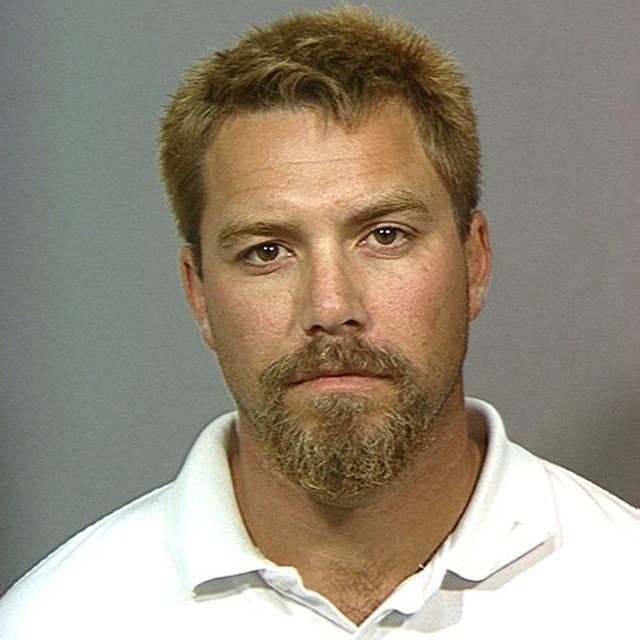
For the last 20 years or so, the horrible murder of Laci Peterson has been in and out of the American papers with ‘shocking revelations’ and ‘new information’. Poor Laci was senselessly murdered by her self-obsessed husband who has now become the poster child for everything that’s wrong about privileged criminals in the States. Most recently the LA Innocence Project has taken on Scott Peterson’s case in hope of conjuring up some new DNA results that will free their hero.
I have always found crime stories from my hometown very interesting. There is a little-known story about the murder of Scott’s grandfather that has always made me think. Scott’s mum, Jackie, was only two and half years old and lived with her parents and three brothers on West Point Loma Blvd. The site is now a condo complex that butts onto a tennis centre.
Her father, John Harvey Latham Sr (32), moved to the San Diego beach area from Los Angeles in the 1920s. He graduated Point Loma High School and eventually managed the filling station on the nearby corner of Canon and Rosecrans. There is still a garage on the site and I remember topping up my old Toyota there in the 1980s.
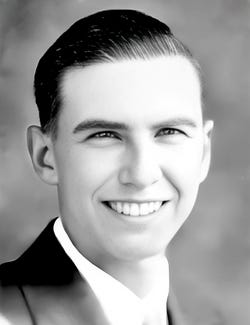
John married his sweetheart named Helen and went back to her home state of Oklahoma for the wedding in 1939. They settled in San Diego and began making a family. Seven years his senior, she was born Leeta Hixon but preferred to be called Helen. He worked long hours and saved up to buy his own business. She was a housewife who was taking care of young four kids: three boys and a girl.
John was the owner of a thriving tire-repair and salvage yard in an area south of downtown now known as Barrio Logan. It was close to the navy shipyards and had a good passing trade from military base in Coronado. It’s still there if you want to check it out at 2190 Main Street.
In 1945, on the Friday morning prior to Christmas, Helen woke to find that John did not return home. She had spoken to him about 9pm the night before. He had called to say he was making a late sale and asked if she needed him to bring anything home with him. He said he would be home shortly. When he did not return an hour later, she assumed he stayed out with the boys for drink, as he often did. But when he did not return home by morning, she frantically called the police.
His body was found in the equipment loading shed by an employee arriving for work at 7am. They thought it was odd to see the office lights still on and the front gate open. John had been bludgeoned to death from behind and then rolled on to his back. Police described it as a “crushing skull fracture”. He was wearing his street clothes and not his dirty work dungarees, so it could be concluded he was about to leave for home.
The police search revealed no money on site and an empty wallet next to the body. John was known to carry large amounts of money in case he needed to make an immediate salvage purchase. He was also known to carry the daily takings home in a canvas bag after closing up. Police decided it was a robbery gone wrong.
There was a rusty thirty-three-inch length of pipe left at the scene. Police determined he was struck once on the back of the head as he walked out of the office. He then would have fallen forward on to his face in the adjoining shed. It looked like he either knew his attacker or had invited them into the office as there was no forced entry. The pipe was far too rusty to obtain decent fingerprints but they tested it anyway. Their assumption was correct and the weapon yielded zero results.
About two hours later, police arrested a former employee named Robert Sewell (25). John had recently fired Sewell from his tire changing and recapping job at the yard. Sewell said he knew nothing about it and had an alibi. He said he was staying with his wife in a Downtown hotel and was nowhere near the salvage yard. He told them he went to a few cafes about 7pm and returned a few hours later. He said he left the hotel again to grab a bite to eat with his wife and arrived back about 11:30pm to sleep.
Robert Sewell was released by the police that evening while the police verified his full alibi. He left San Diego soon afterwards and the case went cold.
Just over three years later in early 1949, Sewell returned to San Diego and was observed to be intoxicated. Police placed him under arrest and charged him with drunkenness and suspicion of robbery. They took him downtown and interrogated him once again but did not get a confession. His story had now changed to say he was playing pool and gambling with dice that evening but did not kill anyone. The following morning Sewell was sentenced to jail for 20 days for public drunkenness.
As it turns out a close and personal friend of Sewell’s had already told to police what they needed to know. Robert Massey was up on charges and was looking for a way out. He told the cops that Sewell confessed to a murder in San Diego. Massey said they were drinking together in the summer of 1946 and each were bragging about their criminal activities when Sewell told all.
The police brought Sewell into an integration room to find Massey standing there with detectives. According to police, Sewell took one look at Massey and said he was ready to make a statement. They took him to a separate room where he confessed to the crime. Massey got a reduced sentence.
Sewell told police he went down to John’s salvage yard to steal from him about 8 or 8:30pm. As he was about to enter, he saw John counting receipts through office window and then looked around finding the length of pipe. He waited for John to exit the office and away from the door frame before he struck.
According to the police, Sewell said, “He walked out and I was standing right over there, and I just boom, let him have it… He was coming out of the door. I was standing like that. He made a step, and I just crowned him. He came out just like he is standing there, and I hit him on the head, and he fell on an angle like that, on his arm, and he didn't move, and I got kinda nervous.”
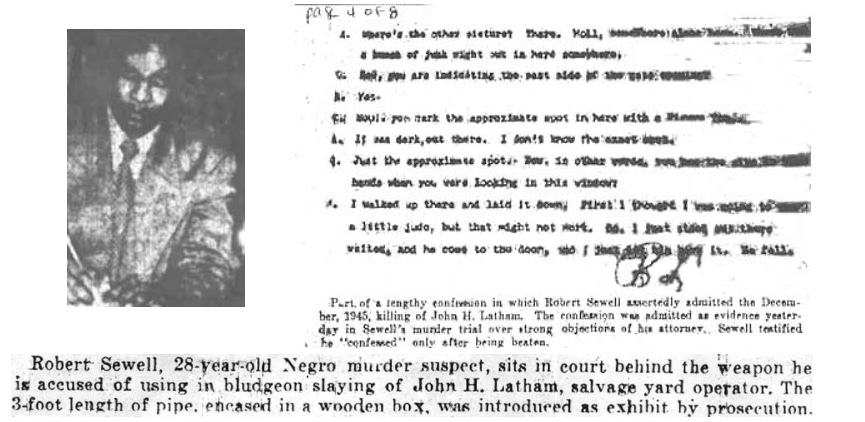
Sewell said he searched John’s pockets, emptied his wallet and then took about $100 from the desk drawer. He shot back up to his downtown hotel and told his wife he struck it rich pulling a job in Linda Vista. The morning after the murder, he paid is hotel arrears of about $20 and bought two bus tickets to Los Angeles. A few months later he returned to his hometown of Montgomery, Alabama until his return to San Diego in 1949.
Prior to his first court hearing, Sewell made strong allegations of a forced confession. He claimed he was punched and had his eyes gouged by police detectives. The department quickly produced photos taken the day after the confession and backed it up with testimony from the stenographer who said she saw nothing of the kind during the interview.
A jury took 4 hours to find the defendant unanimously guilty of first-degree murder. He was lucky to only be sentenced to life imprisonment rather than a date with the gas chamber. Sewell stood with no emotion as the verdict was read. Sobs could be heard from his wife in the back of the court as she collapsed in the spectator gallery. All appeals and new trial motions were denied and Sewell took up residence at San Quentin State Prison.
Helen was so distraught from the loss that she was unable to care for the four children and placed them into Nazareth House orphanage. She was permitted weekly visits until she became unwell and eventually died in 1962, aged 55. Nazareth House is still there but is a senior living community now.
Scott Peterson’s mum Jackie, John and Helen’s only daughter, shared her traumatic experience as a child during her son’s penalty phase for the murder. Jackie owned a tiny boutique in La Jolla called “The Put On” while Scott was growing up and died in 2013. My mother shopped almost exclusively in La Jolla and had never heard of it. Or at least she is sticking to that story.

In very strange circumstances, Sewell passed away suddenly of pneumonia following a kidney infection in early 1951. There are little records to review in regard to his passing and there is a discrepancy in ages on his death certificate and army file. Prison records say he was 30 years old when he died.
Sewell was in San Quentin for less than two years before his untimely death. Strangely, his victim’s grandson would spend 17 years on the same cell block at the famous prison by the bay. Peterson was transferred to Mule Creek in October 2022 and managed to seduce the LA Innocence Project to take on his appeal.