


Continued from Friday…
At 2.10pm, Olson suggested she should surrender, and Brenda said she would think about it. He suggested they hang up for a while and said he would call back in 20 minutes. After consulting fellow detectives about how best to end the siege, he called again and suggested she leave the house and lie face down with her hands above her head.
Brenda refused but began asking questions about her eventual arrest: whether she was going to juvenile detention or the police station, whether she would be handcuffed, whether she would be given a lawyer, and what the charges would be. Olson understood that she wanted to be taken from the scene in handcuffs. He said the charges were not up to him, but that a lawyer would be provided if she requested one once she was in custody. He also reminded her that the Whopper she had asked for would be hers once she was in the police vehicle.
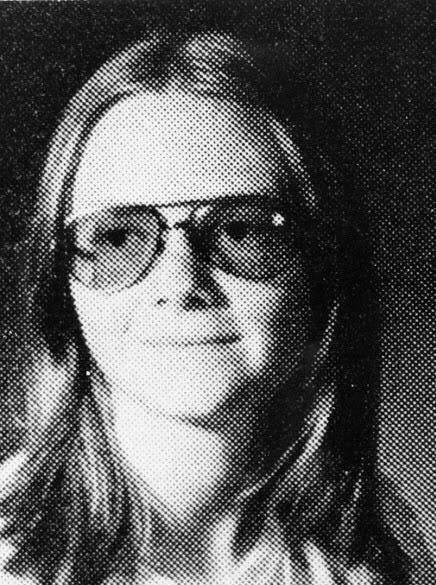
Switching topics, Brenda said: ‘Bugs Bunny will be coming on at three o’clock. Let me tell you, watching Bugs Bunny and listening to the stereo is really something.’ Then she said: ‘If I shoot at the police, they will shoot back.’ Olson responded: ‘That’s not a good idea, Brenda. You don’t really want to do that. If you have been watching the SWAT movies, you know that if a police sniper is assigned to do his job, it will end in tragedy.’
Brenda became increasingly agitated, and the negotiators believed she was considering another attack. ‘If you do that, Brenda, I can’t control the SWAT officers,’ Olson said. Searching for something she could identify with, he added that officers would probably use gas and that her pet animals might die from the fumes.
Brenda had spoken about having a rat, a snake and a dog, but she did not give in. ‘Well, if that’s what has to be done, that’s what has to be done. They have to take care of themselves,’ she said. Then she asked whether she was on television. Olson replied that there was plenty of media interest outside. ‘That’s great!’ she said.
She then said she would sit back and think about things. ‘Keep talking to me. You’re making progress,’ Olson replied. They continued to speak, and Brenda relaxed her position and finally agreed to leave her house and place her rifles on the ground. She would then re-enter the house and bring out the ammunition.
Brenda asked: ‘Should I leave the rifle unloaded or loaded?’ Olson suggested she unload it. A few minutes later, 16-year-old Brenda Spencer casually left her house carrying her new .22 rifle and her pellet gun covered in a sweatshirt. She unwrapped the guns and slowly laid them next to each other, then calmly wandered back into the house and got back on the phone as instructed.
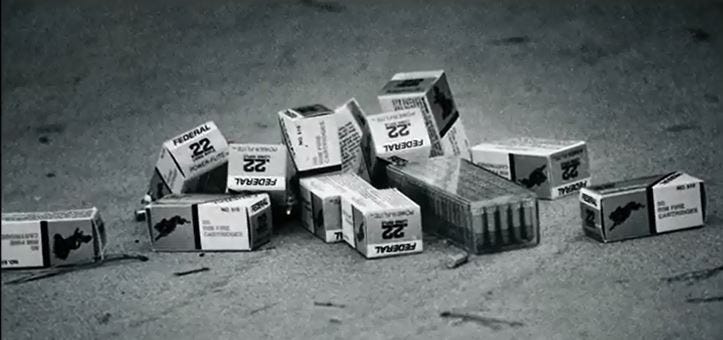
To Olson, she was eager and co-operative, so he asked her to pick up all the ammunition and place it outside, not too close to the weapons. ‘It’ll take me a while. There’s ammunition all over the house,’ she replied. Five minutes later she came back on the phone and said: ‘Okay, I’ve got it.’ Then she exited her house for the final time with an armful of .22 ammunition.
She walked to the end of the driveway, stepping around the two rifles before lowering the ammunition boxes. On her right, two SWAT team members with shotguns had sneaked forward and into her view. A few other SWAT officers raced towards her from her left. Brenda did not resist but was startled as she rose slowly to her feet. She was apprehended at 3.06pm, seven hours after her first shots on the school. Her hands were cuffed behind her back as she was led away.
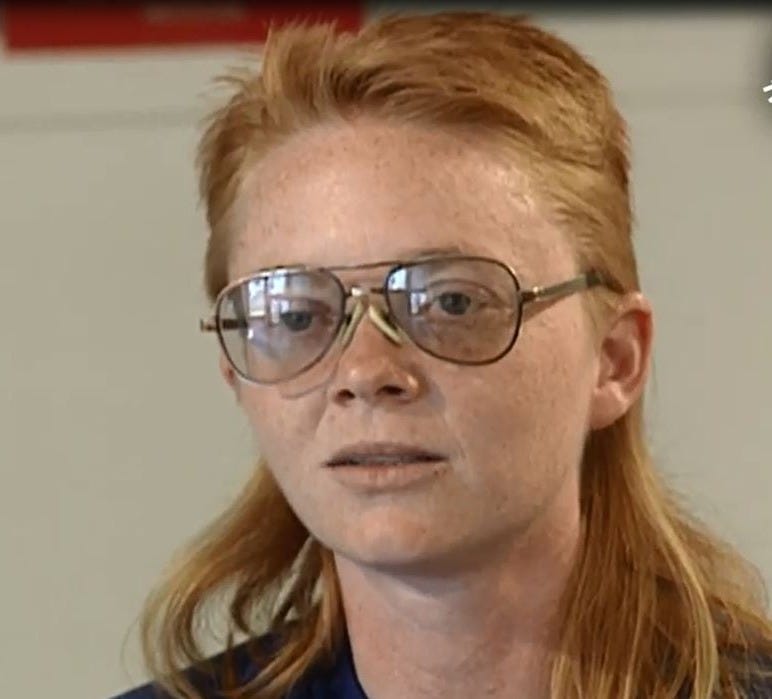
For the first time, the world got sight of the deadly sniper who had callously and without rhyme or reason killed two people and seriously wounded a number of young children. Brenda Spencer stood only 5ft 1in and weighed just six-and-a-half stone. She dressed in boys’ clothes and, even though she was soon turning 17, she looked years younger. Painfully skinny and slight, she had long orange hair reaching to the middle of her back.
Even as a child she had often looked as if she had never seen a comb; perhaps this was because she did not live with her mother and did not have a close relationship with her older sister.
In court many months later, Brenda pleaded guilty to two counts of murder in the first degree. She also pleaded guilty to several counts of assault with a deadly weapon. She was unemotional until Judge McMillan asked her what happened that day. With tears in her eyes, she replied in a low voice: ‘I shot from my house and killed two people.’ To the 11 other charges, she simply whispered, ‘Guilty.’
She was sentenced to 25 years to life in prison, but with the chance of parole one day. Today, 47 years later, she is still in prison, having had numerous parole applications refused. In those hearings she claimed she had been sexually abused by her father – which he denies. Although neighbours and acquaintances had their suspicions, the author could find no independent confirmation of this. She also hated her mother for leaving and breaking up the family.
She claimed she had been high on drugs and alcohol, though a blood test when she was arrested showed no such stimulants. She also claimed she had intended to shoot over the children’s heads, though all the evidence contradicts this. On another occasion, she said she was hallucinating when she carried out the shootings and that voices in her head would not let her stop. One parole board after another felt these explanations indicated that she had not accepted full responsibility for her actions.
Behind bars, she became something of a model prisoner. She attended Alcoholics Anonymous and Narcotics Anonymous activities, completed anger-management and self-help courses, studied animal grooming, took vocational electronics and hobby and craft classes, and attained a qualification as an electrical test technician.
She earned top marks in upholstery, obtained her driving licence so she could work in the prison’s car repair shop, and became an accredited forklift driver working in the prison warehouse. She helped other inmates learn to read, played for the prison softball team, performed in a musical group and, for many years, created a garden in the prison.
It did not help her argument for release that she had become one of the most famous criminals in the United States. The Boomtown Rats’ song I Don’t Like Mondays, based on what she had told a newspaper reporter as the reason for her killing spree, propelled her to the status of an international poster child for evil. Interestingly, she told her parole board last year that she did not remember saying that.
In 1979, the school-shooter phenomenon was rare, and for the perpetrator to be a young woman was rarer still. It is also unusual for a school shooter to survive. As a result, whenever another school shooting occurs, her crime is brought up again.
In making her case for parole, Brenda said: ‘I’m really deeply sorry for what I’ve done. I know that saying sorry doesn’t make it all right. Not a day goes by that I don’t think about what I did and I realise that not only the people I hurt are victims but everyone who went to that school, their family and friends.’
She was opposed vociferously at every parole hearing by Cam Miller, who was nine when shot by Brenda just one inch from his heart. ‘She clearly has no regard for human lives,’ he told a hearing in 2001. ‘She was shooting to kill any human target that walked into her path. She is a cold-hearted ruthless murderer who needs to be in prison for the rest of her life for the safety of the community.’
Crystal Hardy, who was ten when Brenda shot her through the wrist, said: ‘She shot children, a police officer, and adults trying to help. I have images of those bodies in the bushes, and they never leave me. Nothing can fix that. There is solace in knowing she is in prison.’
And so, more than 47 years after she took her rifle and brought slaughter and terror to a primary school, she is still in prison, but remains a paradox. Despite having been examined by numerous doctors and psychologists, to this day we are no closer to understanding why she did what she did.
Great read! As someone with only a passing knowledge of this event, I found your book incredibly engaging and informative.